
![How to Choose the Best SD Card for Your Dash Cam [2026 Guide]](http://cansonic.com/cdn/shop/articles/UltraDash_Z4_dual_lens_dashcam_and_memory_card.webp?v=1788417153&width=1200)
How to Choose the Best SD Card for Your Dash Cam [2026 Guide]
Quick Summary: > Choosing the wrong memory card can lead to corrupted files and missed accident footage. To ensure your dash cam works perfectly when you need it most, you must pick the right SD card. In this quick guide, we break down the 7 crucial factors you need to know: from picking reliable brands and understanding the right capacity (size), to choosing U3 speed classes for 4K recording and spotting fake counterfeit cards. Let's find the most durable SD card for your daily driving!
7 Key Factors to Consider When Buying a Dash Cam SD Card
Choosing the right SD card for your dash cam depends on several factors, from your daily driving habits to your camera's video resolution. With so many options on the market, making the right choice is crucial for reliable recording. Below, we break down the 7 key factors to consider when selecting and maintaining the perfect SD card for your needs.

1. SD Card Brand
Opting for a popular name brand doesn’t guarantee an SD card will last forever, but we highly recommend sticking to reputable manufacturers like SanDisk or Kingston. Regardless of the brand, memory cards are consumable items. For optimal safety, we strongly advise checking your SD card’s footage every month and replacing the card annually to ensure it's still functioning properly.
2. SD Card Type
There are two common types of memory cards: standard SD and microSD. Most modern dash cams require a microSD card. Typically, these come with a full-size SD adapter in the packaging. You will use this adapter when inserting the microSD card into your laptop or PC to review your footage.

3. SD Card Format
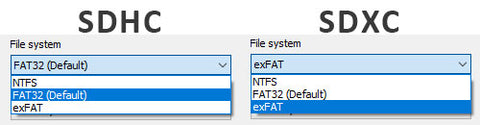
You’ll usually encounter two formats: SDHC and SDXC. To avoid compatibility issues and corruption, always format your card directly inside the dash cam. If you must format it on a computer, use FAT32 for SDHC and exFAT for SDXC. Most importantly, never save personal files or music on your dash cam's SD card, as this can corrupt your video recordings.
4. SD Card Size (Capacity)
Memory capacities range anywhere from 4GB to over 400GB. You’ll notice specific markings on the card: SDHC (4GB to 32GB) and SDXC (64GB and above). Keep in mind that the actual usable storage is always slightly less than the listed size (e.g., an 8GB card offers about 7.4GB).
As a rule of thumb, one minute of 1080P footage takes up about 100MB. For a standard daily commuter, an 8GB to 32GB card is usually sufficient because dash cams use loop recording—automatically overwriting the oldest, unprotected files. Always check your dash cam's maximum supported capacity before purchasing.
5. SD Card Speed
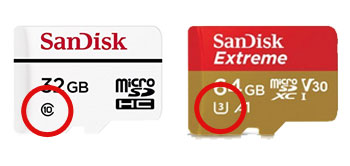
With dash cams recording at higher resolutions and bit rates, write speed is more critical than ever. Look for the speed class markings on the card:
-
Class 4: 4 MB/s
-
Class 6: 6 MB/s
-
Class 10: 10 MB/s
-
UHS Speed Class 1 (U1): 10 MB/s
-
UHS Speed Class 3 (U3): 30 MB/s
For smooth Full HD 1080P video, you must use a card with a minimum write speed of Class 10 or U1.
For smooth UHD 4K or 2K video, you must use a card with a minimum write speed of U3.
6. Fake cards:
It is not easy to distinguish between genuine and fake cards when purchasing online. If the price of the micro SD card is too good to be true or if the text on the card and packaging is misaligned or poorly printed, most likely it is a fake. The best way to get a decent SD card is by purchasing from the manufacture’s website or reliable sellers. You may find a lot of sellers offer cheap or fake SD cards on the internet. Please don’t buy these cards just to save a small amount of money. These cards may break much sooner and cause damage to your important video files.
7. SD Cards for 4K Video
Recording in 4K demands significantly more power and storage. To ensure reliable, smooth footage without dropped frames, you need a high-speed card. One minute of 4K 30FPS video takes up roughly 450MB. Therefore, we strictly recommend using a U3 microSD card for 4K dash cams.
Pro Tip: Due to the massive file size of 4K videos, playback directly from the SD card on your computer might be choppy or lagging. Simply copy the video file to your computer's hard drive first for a seamless viewing experience.
Conclusion
A common issue drivers face is their memory card filling up too quickly with "protected" files. If this happens, try lowering the sensitivity level in your dash cam's G-Sensor and Parking Mode settings. When too much space is taken up by protected files, your loop recording space shrinks, which forces the card to overwrite the remaining free space more frequently—drastically decreasing its lifespan.
Remember, an SD card's lifespan is limited, ranging from a few months to a couple of years depending on usage. Format your memory card once a month to keep it healthy, and replace it the moment it becomes unreliable. If your budget allows, we strongly recommend investing in memory cards specifically designed for constant rewriting, such as the SanDisk Max Endurance/ SanDisk Pro Extreme or Samsung EVO Plus / Samsung Pro Endurance. These will significantly outlast standard SD cards in a dash cam environment.
Disclaimer:
-
Samsung and all related trademarks are the property of Samsung Electronics Co., Ltd. This website/product is not affiliated with, endorsed by, or sponsored by Samsung. Any reference to Samsung products is solely for compatibility and usage recommendation purposes.
-
SanDisk and related trademarks are the property of Western Digital Corporation. This website/product is not affiliated with, endorsed by, or sponsored by SanDisk or Western Digital. Any reference to SanDisk products is solely for compatibility and usage recommendation purposes.


Disclaimer:
Samsung and all related trademarks are the property of Samsung Electronics Co., Ltd.
This website/product is not affiliated with, endorsed by, or sponsored by Samsung.
Any reference to Samsung products is solely for compatibility and usage recommendation purposes.
SanDisk and related trademarks are the property of Western Digital Corporation.
This website/product is not affiliated with, endorsed by, or sponsored by SanDisk or Western Digital.
Any reference to SanDisk products is solely for compatibility and usage recommendation purposes.
Learn more:
UltraDash C1. The Best Value For Your Money
7 Reasons Why you need a Dash Cam
7 Easy Steps to Install a Dash Cam Yourself
How to Hardwire Dash Cam Installation Guide Step-by-step
The 5 Myths of Wi-Fi Function on Dash Cams
How to Use OTG Device with Phone to Watch, Edit and Share Dash Cam Footage
Four Factors that Affect GPS Logger Positioning Quality of Dash Cams
Five Key Points of Choosing a Dash cam for Ridesharing Taxi, Uber and Lyft Driver
Five Simple Ways To Troubleshoot Common Dashcam Glitches
Does TESLA need an additional dash cam?
Easy Installation Of 3M Adhesive Dash Cam Bracket + Static Side Film
How to Reduce Jello Effect Caused by Car Vibrations in The Footage Recorded by A Dash Cam?


